AEO vs GEO vs SEO: What’s the Difference (and What Do You Need)?
SEO, AEO, GEO — three acronyms, one question every business owner is asking: what do I actually need to do so customers find me? Here’s the plain-English version, without the jargon.
Search used to mean one thing: you typed a few words into Google and got ten blue links. Today the same customer might get an AI-written answer at the top of Google, ask ChatGPT for a recommendation, or have Perplexity summarize three sources into one paragraph. Each of those surfaces picks winners a little differently — and that’s where the three terms come from.
SEO: ranking in the results
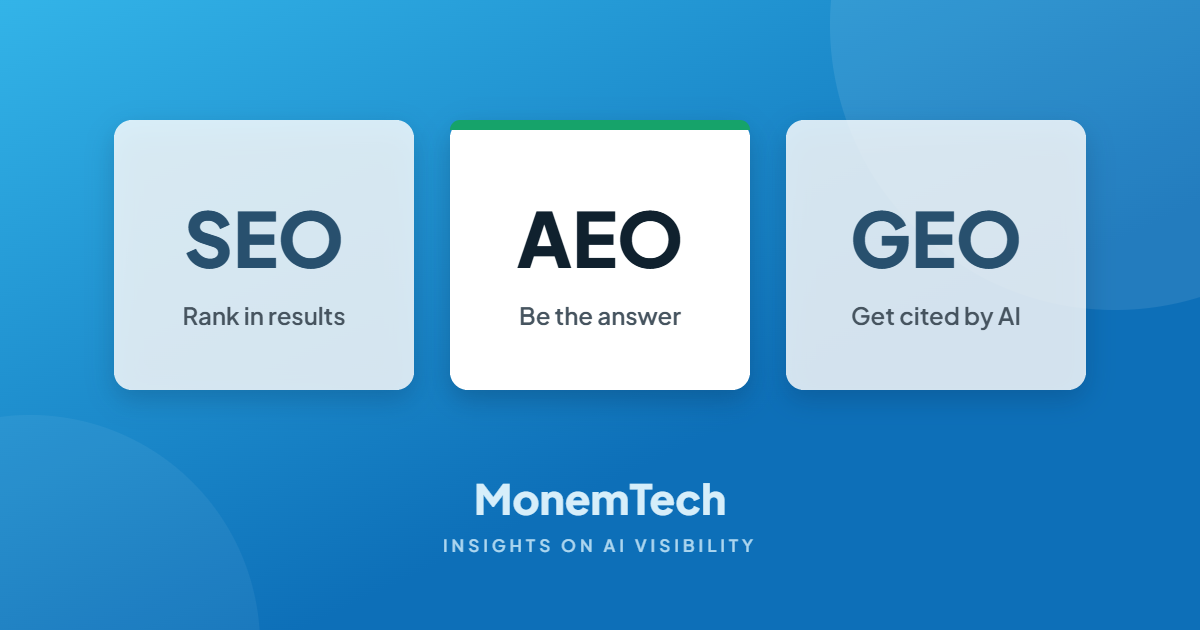
Search Engine Optimization is the discipline most people already know. The goal is to rank as high as possible in the list of results for the searches your customers make. It rests on three things: a site search engines can crawl and understand, content that matches what people search for, and authority — other reputable sites linking to and mentioning you.
SEO isn’t going anywhere. AI answers are built on top of search indexes, so if search engines can’t find and trust your pages, AI tools usually can’t either.
AEO: being the answer
Answer Engine Optimization shifts the goal from “rank on the list” to “be the answer.” Featured snippets, voice assistants, Google’s AI Overviews, and chat assistants all pull out a direct answer rather than showing ten options. AEO is about making your content the easiest, most trustworthy thing for those systems to quote.
In practice that means writing pages that answer real questions directly, structuring them with clear headings, and adding schema markup that tells machines exactly who you are, what you offer, and where. (For a deeper look, see What Is Answer Engine Optimization?)
GEO: getting cited by generative AI
Generative Engine Optimization is the newest term. It focuses specifically on large language model tools — ChatGPT, Gemini, Claude, Perplexity, Copilot — that write an original answer and then cite or name sources. GEO asks: when an AI writes a response about your category, does it mention you, and does it describe you accurately?
GEO leans heavily on signals outside your own website: consistent business listings, reviews, press mentions, directory profiles, and how often credible sources talk about you in the same breath as your specialty.
The honest truth: AEO and GEO overlap so much that many people use them interchangeably. Don’t get hung up on the label. What matters is whether you show up when customers ask — in a search box or a chat window.
How the three fit together
- SEO is the foundation. Crawlable pages, fast load times, solid content and real authority. Without this, nothing else works.
- AEO is the formatting layer. Clear question-and-answer content plus structured data so machines can lift the right answer.
- GEO is the reputation layer. Consistent facts about your business across the web, so AI models trust and repeat them.
They aren’t competing strategies. They’re three floors of the same building — and a business that only works on one floor leaves customers on the others.
Which one does a small business need first?
Almost always: fix the foundation, then layer on answers, then build reputation. A practical order looks like this:
- Make sure you can be found at all. Your site loads fast, is indexed in Google and Bing, and doesn’t block AI crawlers.
- Answer the questions customers actually ask. Service pages that name the specific services, locations and outcomes — not just slogans.
- Add structured data. LocalBusiness or ProfessionalService schema, FAQ schema, and accurate contact details.
- Clean up your listings. Same name, address and phone everywhere — Google Business Profile, Bing Places, Yelp, industry directories.
- Measure AI mentions. Ask ChatGPT, Gemini and Perplexity the questions your customers ask, and track whether you’re named.
Frequently asked questions
Is SEO dead because of AI?
No. AI answers are built on top of search indexes and the same quality signals SEO has always relied on. Strong SEO makes AEO and GEO easier, not obsolete.
Is GEO different from AEO?
Slightly. AEO covers any system that gives a direct answer, including featured snippets and voice assistants. GEO focuses on generative AI tools that write responses and cite sources. The work involved overlaps heavily.
How long does it take to show up in AI answers?
It varies by category and competition. Technical fixes and schema can be picked up within weeks of being recrawled; reputation signals like reviews and mentions build over months.
Not sure where you stand?
I’ll check how search engines and AI assistants see your business today — and show you the first three fixes that would move the needle.