SEO vs AEO: Which One Does Your Business Need?
The honest answer: it depends on where your customers are asking questions. And increasingly, they’re not asking Google.
They’re opening ChatGPT, Gemini, or Perplexity and typing something like “Who’s the best dermatologist near me?” or “Which accounting firm should I trust for my small business?” Those aren’t search queries — they’re conversations. And the engine answering them doesn’t return a list of blue links. It names a business, explains why, and moves on.
That’s the gap SEO alone can’t close.
What SEO Actually Does
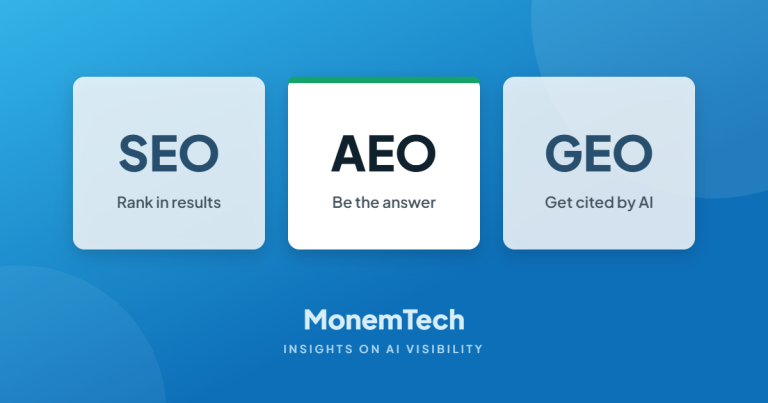
Search Engine Optimization is built around ranking in traditional search results — primarily Google and Bing. You optimize your pages, earn backlinks, load fast, and target keywords so that when someone searches, your site appears near the top.
It works. It’s still valuable. For businesses that rely on organic Google traffic, a solid SEO foundation isn’t optional.
But SEO was designed for a world where users click links. That world is shrinking.
What AEO Does Differently
Answer Engine Optimization — sometimes called GEO (Generative Engine Optimization) — is about getting your business cited, recommended, or surfaced by AI systems. Not ranked. Recommended.
When an AI model answers a question, it’s drawing on training data, live web content, structured information, and signals about authority and relevance. The businesses that show up aren’t necessarily the ones with the most backlinks. They’re the ones whose content clearly answers the question, whose data is structured in a way AI can parse, and whose digital presence signals genuine expertise.
That’s a different game.
Where They Overlap — and Where They Don’t
Good content helps both. A well-written page that answers a specific question clearly will perform in traditional search and give AI models something useful to cite. That overlap is real and worth leaning into.
The differences show up in the details:
- SEO prioritizes keyword density, backlink profiles, and click-through rates. AEO prioritizes clarity, structured data, and topical authority.
- SEO success is measured in rankings and organic traffic. AEO success shows up when AI tools name your business in a response.
- SEO targets users who are already searching. AEO targets AI systems that are synthesizing answers before a user even thinks to search.
One thing AEO requires that SEO doesn’t: you have to think about how an AI model reads your content, not just how a human does. Schema markup, FAQ structure, clear entity definitions — these matter more than they ever did for traditional search.
So Which One Should You Focus On?
If your customers are still primarily finding you through Google searches, SEO remains essential. Don’t abandon it.
But if your customers are the kind of people who ask AI assistants for recommendations — and most consumer-facing businesses should assume they are — then AEO isn’t a future concern. It’s a current one. Your competitors may already be showing up in those AI responses. You might not be.
The smartest approach treats them as complementary. Build content that’s genuinely useful and well-structured. Use schema and structured data. Make sure your business’s expertise, location, and services are unambiguous across your digital presence. That work serves both goals.
What MonemTech Does About This
At MonemTech, AI visibility is the core of what we do. We help businesses understand where they stand with AI right now — what ChatGPT, Gemini, and Perplexity are saying about them — and then we close the gap with content, structured data, and automation built specifically for answer engines.
No jargon, no guesswork. Just a clear picture of where AI sends your customers today, and a plan to make sure the answer is you.
Curious where you stand? Book a free consultation and we’ll show you exactly what AI is saying about your business.